Ablytx develops Sheddase-Targeting Chimeras SHEDTACs
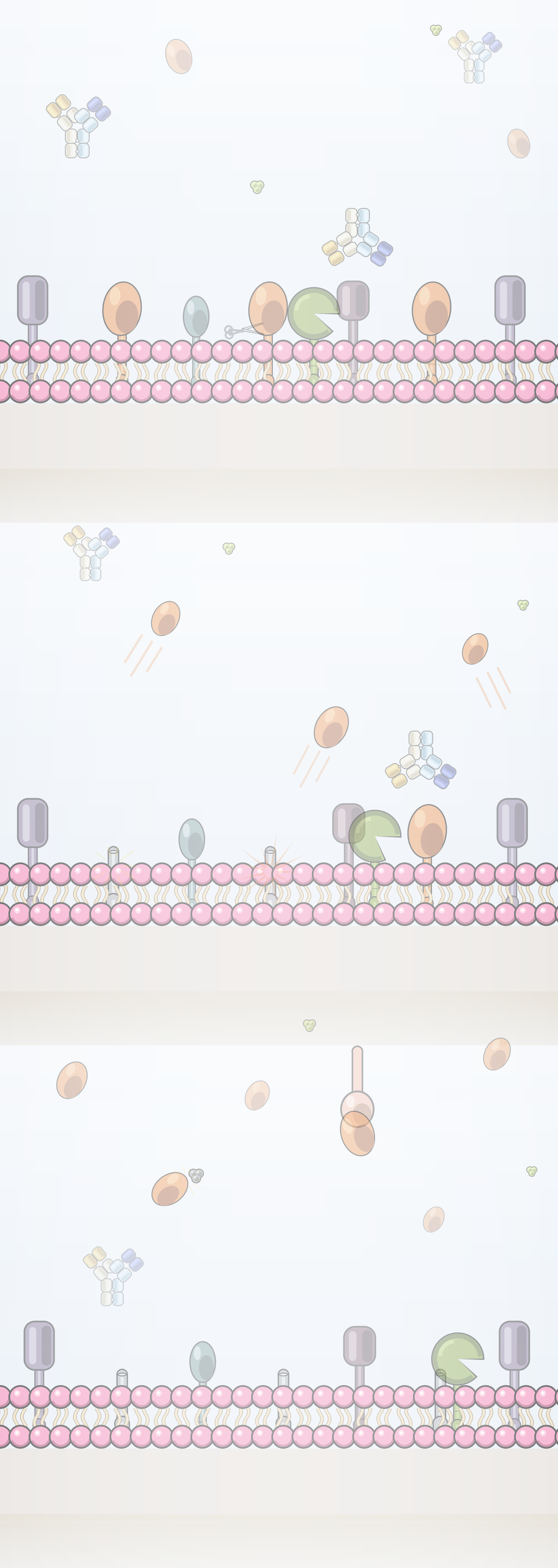
Bispecific antibodies that recruit the cell's own membrane proteases (sheddases) to directly cut disease-driving proteins off the cell surface.
A novel effector class among induced proximity modalities.
Cells already shed surface proteins. SHEDTACs enable scientists to choose which one.
Membrane-anchored proteases (sheddases) constantly trim proteins off the cell surface — regulated ectodomain shedding, a normal physiological process. SHEDTACs redirect that machinery to a substrate of choice, a new effector class among induced-proximity modalities.
Antibody-defined selectivity, enzyme-driven turnover.
Sheddases are naturally promiscuous — on their own, they cut broadly
SHEDTAC binding arms determine which protein is shed, leaving adjacent, off-target receptors on the same membrane unaffected.
The effector is not consumed, so a single sheddase supports iterative rounds of cleavage — catalytic pharmacology.
Surface proteins have been easier to block than to remove.
While antibodies have transformed medicine by blocking targets, occupancy-based drugs leave proteins in place, still able to signal.
Targeted protein degradation (TPD) solved removal inside the cell, where the ubiquitin–proteasome machinery lives.
Extracellular TPD (eTPD) reaches the surface by dragging targets inward to the endolysosome, which only works if the target internalizes and a suitable shuttle receptor exists.
SHEDTACs remove the target where it sits, at the cell surface, with no trafficking required.
Each cleavage releases a soluble ectodomain into circulation, turning target engagement from an inferred parameter into one measurable in patient serum.
Shed fragments keep their ligand-binding domains and can be employed as a ligand sink.
Soluble receptor ectodomains are already a validated drug class (e.g. etanercept, aflibercept) — SHEDTACs generate them in situ.
One cut, three benefits.
A modality built for the surface proteome.
Modular and extendable across membrane targets that have proven refractory to internalization-dependent approaches.
SHEDTACs are preclinical; our initial characterization of the mechanism is available as a preprint.